How to Write Test Assertions That Catch Real Bugs
 By Xusheng Yang
A report-export test clicks Export and checks for a success message. It passes even though the downloaded file contains last month's data from a different workspace.
An assertion connects an observation to a requirement. Choosing a meaningful assertion starts with deciding what would make the operation correct, then finding evidence that can distinguish that outcome from a plausible failure.
This is part 9 of Testing Methods in Practice. The report and expected values below are illustrative fixtures, not the output of an executed run.
Derive expectations from a controlled fixture
Prepare a test workspace with two orders in October and one in September. Use recognizable identifiers and known amounts. Select the October reporting period. For this example, the export must contain the two October orders, exclude the September order, and identify the current workspace.
Keep currency, timezone, tax treatment, and rounding explicit. If totals are calculated from a documented rule, compute the expected total independently. Reading the current UI total and asserting that the file repeats it can miss a shared calculation defect.
Build an evidence ladder
| Observation | What it supports | What remains unproven |
|---|---|---|
| Export button was clicked | An interaction occurred | Request acceptance and report creation |
| Success message appeared | UI reported an outcome | File availability and content |
| Download completed | A file was transferred | Correct workspace, period, and rows |
| File has expected headers and record identifiers | Intended data structure and records are present | Every calculation or access rule |
| Independent values and exclusions match | Selected business rules hold for this fixture | Other fixtures and boundary conditions |
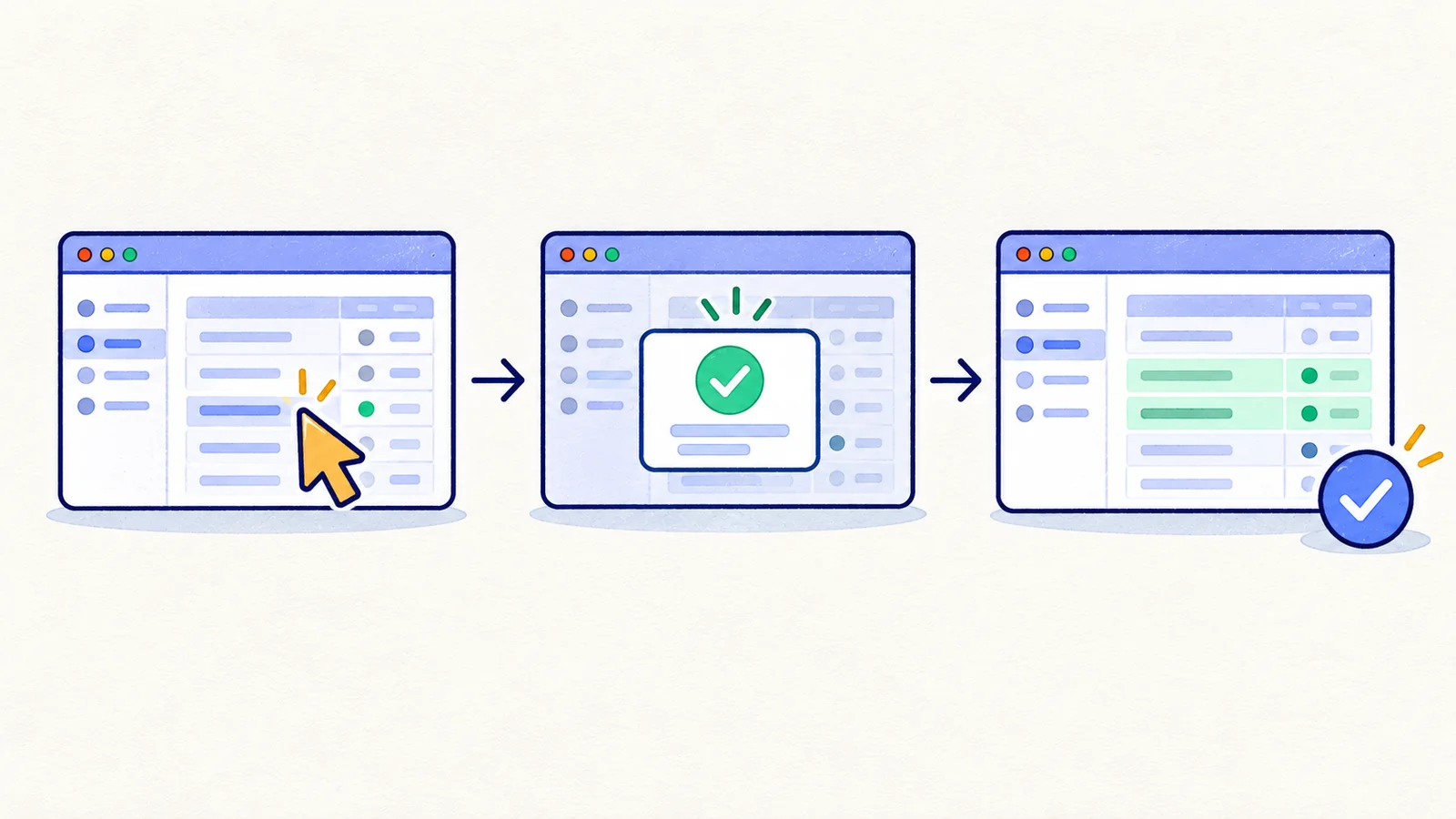
Use the ladder to choose sufficient evidence for the test's claim. A routing smoke check may stop at a usable page. A financial-report acceptance case needs more than the existence of a file.
Make assertions precise without overfitting
For the export, assert stable record identifiers, required columns, expected row membership, relevant values, and forbidden foreign-workspace data. Ignore incidental details such as generated filenames or row order unless the contract requires them.
Use exact text where wording is the requirement, such as a legal statement. For general navigation, a stable accessible role and name can be a useful locator. Keep locating an element separate from deciding whether its behavior is correct.
When the application allows variable order, compare sets while separately checking for duplicates. A set-only comparison can hide repeated rows. When ordering is required, assert the ordered list explicitly.
Wait for the result you intend to inspect
Asynchronous interfaces need bounded waiting. Playwright's web assertions retry checks against the current locator until they pass or time out. That is different from reading a value once and repeatedly checking a stale copy.
This illustrative fragment assumes the application's accessible names and configured Playwright project match the example:
const downloadPromise = page.waitForEvent("download");
await page.getByRole("button", { name: "Export October report" }).click();
const download = await downloadPromise;
expect(await download.failure()).toBeNull();
It establishes a completed download without a reported transfer failure. It does not verify the file's contents. A separate parsing step must compare the saved report with the fixture. Registering the download listener before the click avoids missing a fast event.
Include absence and persistence when they matter
For a denied export, verify that no report job or accessible file is created. A browser can observe a blocked action, but a service test may be needed for hidden side effects.
For a saved preference, reopen it through a fresh read. A success toast and an updated local input can both occur before persistence fails. The existing data-persistence guide provides a detailed workflow for that case.
Keep assertions close to the responsible layer. Exact database invariants belong in controlled backend checks; visible error, focus, and recovery behavior belong in browser or component checks. Claiming more than the evidence can observe makes a green test misleading.
Check whether a known defect would make the test fail
In a disposable test environment, deliberately change the exported period, omit an expected row, or insert a duplicate. Confirm the relevant assertion detects the change. These controlled mutations evaluate the test itself; they are not production experiments.
Your exercise: select a test that currently checks only a toast or heading. Write the requirement it claims to protect, list two realistic defects it would miss, and add the smallest independent assertion that distinguishes each defect. See API/UI consistency testing when the needed evidence spans more than one interface.
Next in the series: Test data isolation.